2025—2026
Exhibition
National Museum of Natural History and Science
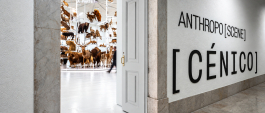
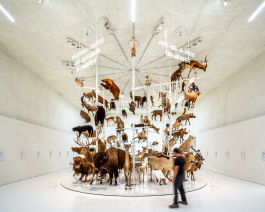
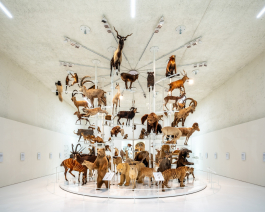
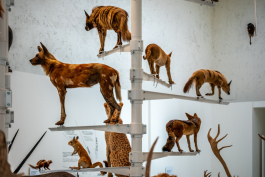
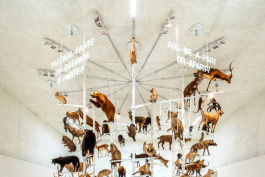
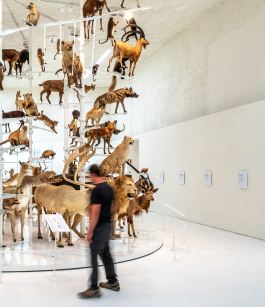
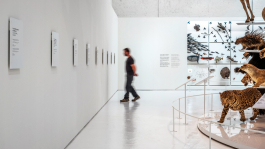
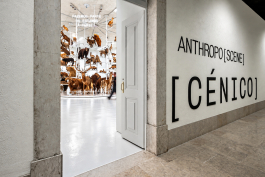
The exhibition is organised around a large central installation, conceived as the defining element of the entire space. Set against a neutral, white and pared-back envelope — closer to the language of an art gallery or a scientific laboratory — the installation becomes an artificial forest, where animals appear suspended within an ecosystem in constant transformation.

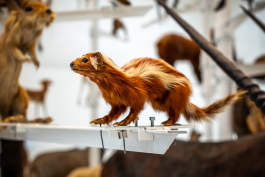
A system of vertical pillars, conceived as “trunks”, supports a modular metal structure whose various “branches” can rotate and be repositioned at different heights.

Each support works independently, allowing the position and orientation of every specimen to be adjusted according to the characteristics of each animal and its relationship with the others.


The structure deliberately reveals its technical and mechanical nature. The contrast between its constructive precision and the organic presence of the animals reinforces the dialogue between nature and science. The result moves away from the traditional language of natural history museums: rather than recreating nature, the exhibition interprets it through a structure that is at once technical, flexible and poetic.


Visitors move around the space as if circling a clearing, almost as though encountering a preserved ecosystem. A direct relationship is established with the animals on display: the visitor observes the animal while, at the same time, being observed by it. Above, a sentence poses the exhibition’s central question: Are we part or apart? An invitation to reflect on humanity’s place in the world and our relationship with nature.

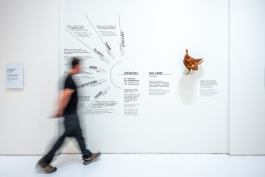
Throughout the exhibition, short texts appear discreetly, like thoughts or questions. Rather than providing answers, the exhibition proposes a series of reflections — at times poetic, at times scientific — encouraging different ways of interpreting the collection and the natural world, with the aim of leaving visitors with a new perspective on their own presence in the world.


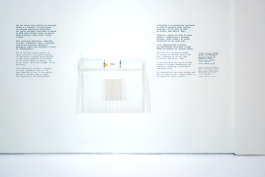
Displayed inside a transparent acrylic tube, the fragment appears almost suspended. The transparency and visual lightness of the structure contrast with the materiality of the stone, while its small scale stands in stark contrast to the magnitude of the event it represents, turning it into a tangible symbol of human impact on the planet.
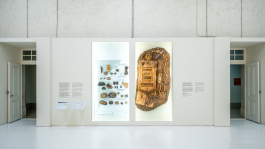
The exhibition concludes with a work by Nature the artist, invited to create a piece specifically for this context. Conceived as a fossil of our time, the work incorporates the image of a petrol pump, transforming an object associated with the fossil-fuel era into an archaeological remnant. As if discovered in a distant future, the piece turns our gaze back to the present and asks what traces our time will leave inscribed in the history of the planet.
Nuno Gusmão
Giuseppe Greco
Jacinta Fialho
José Vicente (Agência Calipo)

2025—2026
Exhibition
National Museum of Natural History and Science
The exhibition is organised around a large central installation, conceived as the defining element of the entire space. Set against a neutral, white and pared-back envelope — closer to the language of an art gallery or a scientific laboratory — the installation becomes an artificial forest, where animals appear suspended within an ecosystem in constant transformation.

A system of vertical pillars, conceived as “trunks”, supports a modular metal structure whose various “branches” can rotate and be repositioned at different heights.

Each support works independently, allowing the position and orientation of every specimen to be adjusted according to the characteristics of each animal and its relationship with the others.


The structure deliberately reveals its technical and mechanical nature. The contrast between its constructive precision and the organic presence of the animals reinforces the dialogue between nature and science. The result moves away from the traditional language of natural history museums: rather than recreating nature, the exhibition interprets it through a structure that is at once technical, flexible and poetic.


Visitors move around the space as if circling a clearing, almost as though encountering a preserved ecosystem. A direct relationship is established with the animals on display: the visitor observes the animal while, at the same time, being observed by it. Above, a sentence poses the exhibition’s central question: Are we part or apart? An invitation to reflect on humanity’s place in the world and our relationship with nature.

Throughout the exhibition, short texts appear discreetly, like thoughts or questions. Rather than providing answers, the exhibition proposes a series of reflections — at times poetic, at times scientific — encouraging different ways of interpreting the collection and the natural world, with the aim of leaving visitors with a new perspective on their own presence in the world.


Displayed inside a transparent acrylic tube, the fragment appears almost suspended. The transparency and visual lightness of the structure contrast with the materiality of the stone, while its small scale stands in stark contrast to the magnitude of the event it represents, turning it into a tangible symbol of human impact on the planet.

The exhibition concludes with a work by Nature the artist, invited to create a piece specifically for this context. Conceived as a fossil of our time, the work incorporates the image of a petrol pump, transforming an object associated with the fossil-fuel era into an archaeological remnant. As if discovered in a distant future, the piece turns our gaze back to the present and asks what traces our time will leave inscribed in the history of the planet.
Nuno Gusmão
Giuseppe Greco
Jacinta Fialho
José Vicente (Agência Calipo)